Kastoria
Accommodation
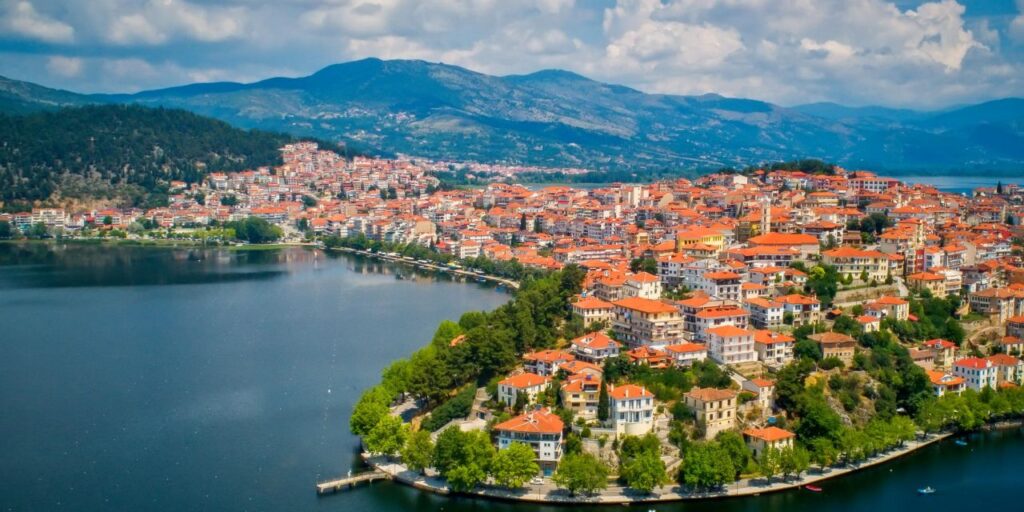
The city of
Kastoria is amphitheatrically built on the peninsula going far
into the lake, reflecting itself into the waters like a
precious gem, thus creating a picture whose beauty and
grandeur fascinates both Greek and foreign visitors. This
traditional West Macedonian city of long history, has
irresistible charms and beauty. Christos Zalokostas has once
said "A few more days in Kastoria and I would never leave
the city again". The city extends between Vitsi and
Grammos, on a small peninsula penetrating Orestiada lake. One
can reach Kastoria following many routes: Athens - Larissa
Kozani Kastoria or Athens Meteors Grevena - Kastoria or
Salonika Edessa - Kastoria or Salonika Veria - Kastoria. Also
Salonika Prespes - Kastoria or through tire former Yugoslavia
borders (Niki) Florina - Kastoria, lgoumenitsa Ioannina -
Neapoli - Kastoria.
All these
itineraries offer to the traveler unforgettable impressions of
landscapes, lakes, rivers, mountains, forests and picturesque
settlements. If on the other hand you love adventure and do
not get easily tired, you can travel by train up to Amintaio
and then by car to Kozani and Kastoria. Finally, if you are
fascinated by air traveling and prefer short cuts, there is a
way for you: You can fly to Kastoria with "short"
aircrafts. Whatever you choose to reach Kastoria, you will
experience a thrill by the beauty that is laid before you even
from the first glance! The houses are built on both sides of
the unrippled mountain and welcome you in a city with strong
traditional color, a city which is determined to keep this
color and never surrender to modern architectural trends.
Facing the area from far, we have the illusion of being at the
seaside, even though the attitude is 650 meters.
Economy:
Kastoria
keeps a leading role to the important sector of National
Exchange. The few Kastorians who created the picturesque 14th
century settlement, would never had impagined that today, the
same area would have been an attraction pole to the world fur
market. Nothing happened by chance. During the past centuries,
the Kastorians worked methodically and continuously. Step by
step they adjusted to the technological developments. They
adopted new commercial standards. They were - and are -
distinguished for their punctuality in business and have
proved their love for the promotion of their craftsmanship not
carrying less for the development of the city as well. The
Kastorian furrier has many qualities.
For years he
has been struggling for living status and economic
development. Due to that fact Kastoria achieved a continuous
production improvement and a thorough adjustment to the
seasonal demands. Kastorian furriers have been worldwide
famous thus being greatly prized in the fur market,
contributing much in the National Economy. Behind the
fascinating production activities, there are three stable
facts: many industries, large fur working capacity,
competitive production. Three facts that can be translated in
numbers: 3500 industrial enterprises, 20.000 workers, 5000 fur
coats capacity per day. Main coordination of this fascinating
and creative activity is the Fur Association of Kastoria which
is founded in 1915. The fur craftsmanship flourished again at
the beginning of the 20th century. The developed activities
urged for the establishment of a Union. In 1915 the
Association of Kastoria Furriers "Profitis Ilias"
was founded. This Association is functioning efficiently up to
now. The President of this Association mentions that economic
figures statistically valued, appear after the Second World
War. Since 1968, besides sewing of fur pieces, the working of
fur consumption began.
The fur
industry's Nourishment influenced not only the economical
prosperity but also the population growth of the city and the
around area. Today Kastoria is the center of world's fur
merchandise, having nothing to fear from other countries,
mainly Eastern, because Kastoria's fur industry claims only
the quality and the tradition of fur making without looking
for the easy profit. Together with the fur industry, in
Kastoria some other productive activities flourish.
"Flokates", rugs, blankets and other similar
products (mainly in Argos Orestikon) are promoted in all other
Greek markets and are distinguished for their quality. All are
hand - made, following the traditional craft of the area.
Agriculture
and cattle breeding are evenly developed. Wheat cultivation
and legumes production too. The beans of Kastoria are well
known and the annual 'production reaches the 16,000 tons. The
apples - famous for their taste - production is estimated to
25,000 tons per year. The Municipality and other local
organizations show an in tense and continuous interest and
care, not only for specified matters, but for general problems
as well. One of the main targets is the further development of
tourism, the protection of Kastoria tradition and the better
exploitation of the lake. The Mayor with the support of the
council and the various local organizations of Kastoria,
evaluate problems and impose regulations always in agreement
with the production class, aiming to the best results. he
philosophy concerning the social, economic, touristy and
cultural upgrading, is based on three terms: Natural beauty,
Tradition and Business activity.
History:
You can
lodge in one of the city hotels, which offer you a pleasant
stay and also unique hospitality. After a short rest, you can
walk through the narrow picturesque streets of the city. An
acquaintance with the history which goes back into the
centuries: Rich prehistoric and archeological findings
(Limneos settlement, Dispilio, Armenohore). But, let's start
from the very beginning.
Kastoria
acquired its name front the Macedonian hero of' Mythology,
Kastor, son of Zeus. The geographical area of Kastoria is
identified as the small ancient Macedonian state of Orestiada,
whose inhabitants were called Orestes and the capital Argos
Orestikon. From that point, according to history, the
Macedonian kings started to merge the rest small states which
formed the big Macedonian state whose capital was Eges
(Vergina) and later, Pella. During the Roman times, the city
of Kastoria had the fate of the rest of Macedonia. Fame and
glamour followed in the Byzantine era. In many places of the
city one can clearly see traces of the fortification dated
from the days of loustinianus protecting the city from
barbarian invasions.
Ruins of the
Byzantine Wall make us conclude that the lake was at those
days, as high as where the modern city is now built. Acropolis
was situated on the highest place where now there is the guest
- room and the reservoir of the city. It is obvious that
during the Bvzantine period many of the inhabitants lived
outside the Wall, at the hill where many churches are saved up
to now.
In the past
Byzantine period, Kastoria has raised many Benefactors and
Teachers of the Nation, while it took part in the 1821
Revolution with a corps of its own people. During the 19th
century, Kastoria participated in the Revolution against the
Turkish and played an important role during the Macedonian
struggle against both Turks and Bulgarians, In 1912, Kastoria
became a part of Greece. Today, Kastoria is a city of 35.000
inhabitants, a city bursting of life and progress, while it
has a strong connection with its history and mythical past.
It is a
challenge to the visitors seeing the 40 or more Byzantine
churches (Temples) and the numerous - around 250 - Macedonian
neo-classical houses. One can see churches appearing at every
crossroad and yard. Inscriptions give us the information that
the churches were built by Kastorians who had lived most of
their lives abroad, or lords in exile, or people of a whole
neighborhood and finally from members of a Trade union. Only
the old ones are clearly shown, the others - built much later
- are placed in the backyards where it is difficult to be
seen. On Omonia Square, the visitors make the first
acquaintance of Kastoria's Byzantine Art. A little further we
can visit Saint Nikolaos Kasnitzi, Taxiarches and Panagia
Koumpelidiki. From the Omonia Square we advise you to visit
Agios Minas Square from Valala street. There, you could find
the Agios Stefanos and Agii Anargiri churches.
Lake:
It is time
now to talk about the priceless beauty of Kastoria. How about
a walk, at sunset, through the streets which run around the
lake, among the planes, willows and weeping willows?
While the
sunbeams paint with red and golden the waters of the lake, the
white swans and the ducks that accompany the fishermen will
draw your attention. At the same time the "boats" of
Kastoria will move slowly on the waters, making you believe
that this is a painting coming back to life.
You can
enjoy the beautiful view sitting on a stone bench by the
seashore or in the fishermen kiosk built with extreme care by
the members of the "Friends of Environment
Association", in their effort to protect the traditional
treasure of the city.
While you
are in the lake, you have to visit the monastery of Panagia
Mavriotissa. You will rest under the gigantic old plane trees,
you will visit the church of Panagia, the katholiko of the
monastery and the chapel of Agios loannis Theologos with the
beautiful frescoes, dated back to the II th century. If you
ask for more information about the history of the monastery,
father Gavriil will be pleased to answer all your questions.
A walk to
the Profiti Ilia, will give you the opportunity to enjoy the
panoramic view of the city and since you are here, do not
hesitate to climb to the shelter of Ai Thanasi, which lays on
a 888 meters altitude. You will be fascinated by the view and
the beauty God has so generously given to this place.
Recreation:
Besides
sightseeing, you can also entertain yourself in Kastoria if
you can arrange being here on the time of various festivities,
or you can indulge in various athletic activities. In
Kastoria, after the initiative of the Municipality and the
Ministry of Culture, some very interesting old customs revive.
"Ragoutsaria", (the Carnival of Kastoria) begin on
New Year's Day, but its peak is from 6 to 8 of January.
"Bourbounes" are celebrated in all neighborhoods
during the Carnival, with festivities and traditional dances.
Today, new activities are added to the old ones: the
"Christopoulia" and the "Week of Expatriated
Kastorians". In the villages, the activities are enriched
with the revival of traditional marriage ceremony, at August
15th, especially in Grammos.
On your free
time we suggest to go fishing which is an unforgettable
experience because of the beauty of the lake and landscape.
You can buy all fishing equipments in the stores of the city.
If you have a sailing boat you can sail and discover another
aspect of Kastoria. From November to March, skiing is the main
entertainment. Vintsi is the skiing resort of the Ski Club of
Kastoria and is situated near the city at a 1800 meters
altitude. You can also go water-skiing the take; skating in
winter is fun too but can be dangerous if you are not skilled
enough, due to the dark sports on the surface of the ice that
break easily. If you hunt, arrange a hunting excursion on the
near mountains, where you can get great pleasure. Finally if
you are an amateur photographer you will find many interesting
spots in the area.
Time for
fun. If you love dancing, there are a lot of discos which
attract the youth. In the suburbs, there are places where you
can listen to Greek popular music. If on the other hand prefer
a romantic evening, you can dine in one of the beautiful
restaurants or taverns where you can try the delicious
specialties. n Kastoria, there are pizza places, coffee shops
along the seashore, pubs, bistros and places with soft music.
For movie lovers, there is a cinema and a movie club. At the
end of' our tribute to Kastoria, we propose you spend a day
outside the center. If you love Nature, the road to Prespes
will offer you an unforgettable experience. You will follow
the road from Aposkcpo, Gavro, Laimo Prespon, where the
National Park is. Before you return to Kastoria, you can have
lunch in the National Tourist Organization or in the village
Psarades, where you can visit the roach paintings.
Agiographies are painted and not engraved on the rocks.
The road to
Kleisoura, Nymfeo and back to Kastoria is for those who are
interested in tradition. If you want to combine entertainment
and information on the industrial progress of the area, you
can follow the road to Ptolemaida, Fragma, Polyfymo and return
via Siatista.
Of equal
beauty is the road from Prespes, ski resort Pissodendri,
Florina, Yugoslavian boarders dnd back to Kastoria via'
Aminteo. If you do have more free time, you can choose a big
variety of sightseeing's with great historical, natural and
cultural interest. You can visit Kleisoura, Nestorio, Argos
Orestiko, Koriso, Mavrochori, Makrochori and Eptachori, and
above all the Arena lake on Grammos, where the landscape
reminds the Alps with the numerous small lakes and waterfalls.
somewhere here, sightseeing in Kastoria and the around area,
ends. |